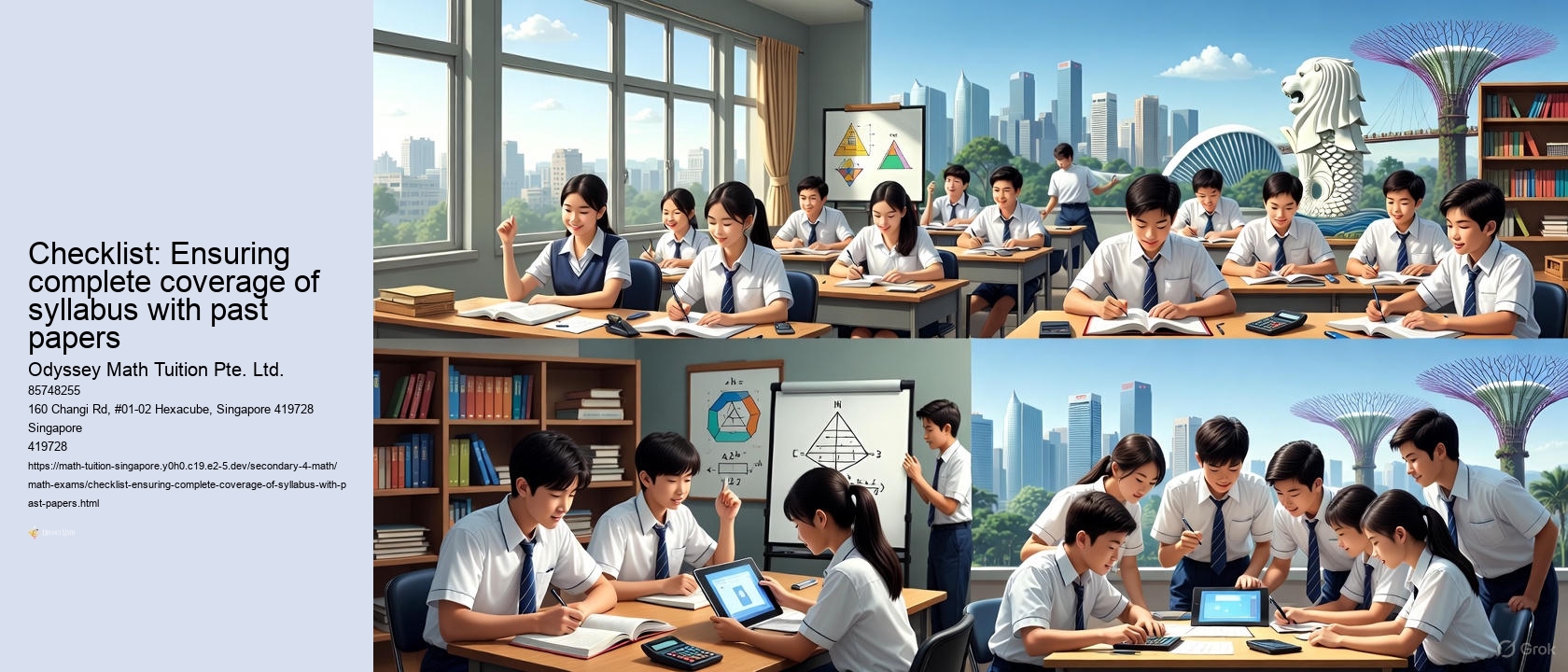
Checklist: Ensuring complete coverage of syllabus with past papers

Checklist: Ensuring complete coverage of syllabus with past papers

Introduction: Mastering Sec 4 Math with Past Papers

Alright, parents and Sec 4 students, listen up! Let's talk about conquering that Math syllabus, kanchiong (anxious) no more! In Singapore, acing your Secondary 4 Math isn't just about memorizing formulas; it's about playing the game strategically. We're talking about shifting from rote learning – you know, just blindly memorizing – to actually understanding and applying those concepts. And the secret weapon? Past papers, lah!

Why past papers? Because they're like a treasure map to exam success! They show you exactly what the examiners are looking for. Think of it as getting insider information on how to excel in Singapore Secondary 4 Math. We're not just talking about getting a passing grade; we're talking about setting your sights high, maybe even aiming for that coveted A1! After all, a strong foundation in mathematics opens doors to so many future careers, especially with AI becoming more and more prevalent these days. Your Math grades aren't just numbers on a report card; they're building blocks for your future!

Fun Fact: Did you know that Singapore consistently ranks among the top countries in the world for mathematics education according to the Trends in International Mathematics and Science Study (TIMSS)? Our education system is known for its rigor, so mastering Math here can really give you a competitive edge!

Checklist: Ensuring Complete Coverage of Syllabus with Past Papers

Okay, so how do we use these past papers effectively? It's not just about doing them once and calling it a day. It's about being systematic and strategic. Here's your checklist to ensure complete syllabus coverage:

  1. Identify Weak Areas: Start by doing a past paper without any notes. See where you struggle. Which topics make you blur like sotong (confused)? This helps you pinpoint your weak areas.
  2. Targeted Revision: Now that you know your weaknesses, focus your revision on those specific topics. Go back to your textbooks, notes, and even consider getting extra help from your teachers or a tutor. Remember, kiasu (afraid to lose out) is good when it comes to studying!
  3. Past Paper Practice: Once you've revised, tackle more past papers. This time, focus on understanding the question types and how to apply the concepts. Time yourself, but don't stress too much at first. The goal is to learn, not just to finish.
  4. Analyze Your Mistakes: This is crucial! Don't just brush off your mistakes. Figure out *why* you made them. Was it a careless error? Did you misunderstand the concept? Did you run out of time? Understanding your mistakes is how you learn and improve.
  5. Repeat and Refine: Keep practicing and analyzing until you feel confident with all the topics. The more past papers you do, the more familiar you'll become with the exam format and the types of questions asked.

Using Past Papers for Exam Preparation

Past papers are more than just practice tests; they're valuable learning tools. Here's how to maximize their effectiveness:

    In the challenging world of Singapore's education system, parents are progressively concentrated on preparing their children with the competencies needed to thrive in challenging math syllabi, encompassing PSLE, O-Level, and A-Level exams. Recognizing early indicators of difficulty in subjects like algebra, geometry, or calculus can bring a world of difference in fostering strength and proficiency over complex problem-solving. Exploring dependable Singapore math tuition options can deliver tailored guidance that corresponds with the national syllabus, ensuring students gain the advantage they need for top exam performances. By emphasizing engaging sessions and steady practice, families can assist their kids not only achieve but exceed academic standards, clearing the way for upcoming chances in demanding fields..
  • Simulate Exam Conditions: When you're doing past papers, try to recreate the actual exam environment. Find a quiet place, set a timer, and don't use any notes or textbooks. In Singapore's demanding education structure, parents fulfill a crucial function in directing their youngsters through key assessments that form academic futures, from the Primary School Leaving Examination (PSLE) which tests fundamental competencies in subjects like numeracy and science, to the GCE O-Level assessments focusing on intermediate mastery in diverse subjects. In today's fast-paced educational environment, many parents in Singapore are looking into effective strategies to improve their children's grasp of mathematical ideas, from basic arithmetic to advanced problem-solving. Creating a strong foundation early on can significantly elevate confidence and academic achievement, aiding students handle school exams and real-world applications with ease. For those considering options like secondary 4 math it's crucial to focus on programs that emphasize personalized learning and experienced support. This method not only addresses individual weaknesses but also fosters a love for the subject, contributing to long-term success in STEM-related fields and beyond.. As students move forward, the GCE A-Level tests necessitate more profound logical skills and subject command, frequently determining tertiary entries and occupational paths. To remain well-informed on all elements of these countrywide assessments, parents should explore formal information on Singapore test papers supplied by the Singapore Examinations and Assessment Board (SEAB). This ensures entry to the newest syllabi, examination calendars, registration specifics, and standards that align with Ministry of Education requirements. Frequently consulting SEAB can help households get ready successfully, reduce uncertainties, and back their offspring in attaining peak performance amid the demanding landscape.. This will help you get used to the pressure of the exam.
  • Focus on Question Types: Pay attention to the different types of questions that are asked. Some questions might require you to apply a specific formula, while others might require you to solve a problem using a more creative approach.
  • Understand the Marking Scheme: Knowing how the exam is marked can help you prioritize your efforts. Some questions might be worth more marks than others, so make sure you allocate your time accordingly.

Time Management Strategies

Time is of the essence during exams. Here's how to manage your time effectively when using past papers:

  • Allocate Time per Question: Before you start a past paper, calculate how much time you have for each question. This will help you stay on track and avoid spending too much time on any one question.
  • Prioritize Questions: Start with the questions you're most confident with. This will give you a confidence boost and help you build momentum.
  • Don't Get Stuck: If you're stuck on a question, don't waste too much time on it. Move on to the next question and come back to it later if you have time.

Interesting Fact: The Singapore Examinations and Assessment Board (SEAB) actually releases past year exam papers for students to use for practice. This shows how important they believe past papers are for exam preparation!

So, there you have it! By using past papers strategically and focusing on understanding the concepts, you can conquer your Sec 4 Math exams and unlock a brighter future. Don't just study hard, study smart, okay? Jiayou (add oil)! You can do it!

Decoding the Syllabus: A Parent's Guide

Checklist: Ensuring Complete Coverage of Syllabus with Past Papers

Okay, parents, let's talk about making sure your Sec 4 kiddo is really ready for those crucial exams. We're not just talking about knowing the formulas; we're talking about understanding the whole shebang! Think of past papers as your treasure map, leading you to exactly where the buried gold (or, you know, those precious marks) lies.

So, how ah? Here’s a checklist to ensure your child has got all bases covered:

  1. Syllabus Alignment: Confirm that the past papers you’re using are aligned with the current year's syllabus. The Ministry of Education (MOE) website is your best friend here. Don't anyhowly download from some shady website, okay? We want the real deal!
  2. Topic Breakdown: Go through the syllabus and identify the key topics. Then, cross-reference them with the questions in the past papers. Are all the topics represented? If not, you might need to find additional resources to cover those gaps.
  3. Weightage Awareness: Some topics carry more weight than others. Identify those high-stakes areas and make sure your child is super solid on them. Past papers will give you a clue on how frequently certain topics appear.
  4. Learning Objectives Check: The syllabus isn't just about topics; it's about what your child should be able to do with that knowledge. Can they apply the concepts to solve problems? Can they explain the underlying principles? Past papers will test these objectives, so pay attention to how questions are phrased.
  5. Error Analysis: Don't just mark the answers right or wrong. In a modern era where ongoing learning is crucial for career progress and self development, leading universities globally are breaking down hurdles by offering a variety of free online courses that span diverse disciplines from computer science and business to social sciences and wellness sciences. These efforts permit learners of all backgrounds to access top-notch lectures, tasks, and resources without the monetary cost of standard admission, frequently through platforms that provide adaptable scheduling and dynamic features. Uncovering online universities free courses unlocks pathways to prestigious universities' insights, allowing proactive learners to upskill at no cost and earn credentials that boost CVs. By making elite instruction readily obtainable online, such programs foster worldwide fairness, empower disadvantaged groups, and foster advancement, proving that excellent knowledge is progressively simply a click away for everyone with web availability.. Dig deeper! Understand why your child made a mistake. Was it a careless error? A misunderstanding of the concept? Or a lack of practice? This is key to targeted improvement.
  6. Time Management: Exam time is precious! Help your child practice answering questions within the allocated time. This is where past papers become invaluable. Set a timer and simulate exam conditions. In the Lion City's bilingual education system, where mastery in Chinese is vital for academic achievement, parents often hunt for ways to support their children conquer the lingua franca's subtleties, from word bank and understanding to writing crafting and verbal abilities. With exams like the PSLE and O-Levels imposing high standards, early assistance can avert common challenges such as subpar grammar or minimal access to traditional contexts that deepen knowledge acquisition. For families aiming to boost outcomes, delving into Singapore Chinese tuition options delivers insights into structured curricula that align with the MOE syllabus and cultivate bilingual confidence. This focused aid not only enhances exam readiness but also instills a greater appreciation for the dialect, opening opportunities to cultural legacy and future career advantages in a diverse environment.. No distractions allowed!
  7. Question Types: Familiarize your child with the different types of questions that appear in the exam. Some questions might require a simple calculation, while others might involve complex problem-solving or proof.
  8. Full Paper Practice: Don't just cherry-pick questions. Encourage your child to complete full past papers under exam conditions. This will help them build stamina and get a feel for the overall exam experience.
  9. Review and Reflect: After completing a past paper, take time to review the answers and reflect on the performance. What went well? What could be improved? What are the recurring mistakes?
  10. Seek Help When Needed: If your child is struggling with certain topics, don't hesitate to seek help from a teacher, tutor, or online resources. No shame in asking for help, okay? Better to clarify now than to regret later.

Remember, parents, how to excel in singapore secondary 4 math is not just about memorizing formulas. It's about understanding the concepts, applying them effectively, and practicing consistently. By using past papers strategically and following this checklist, you can help your child ace those exams and unlock their full potential. Jiayou!

Fun fact: Did you know that the modern concept of algebra, which forms a significant part of Secondary 4 math, was developed by Persian mathematician Muhammad al-Khwarizmi in the 9th century? So, when your child is struggling with algebra, remind them they're tackling problems that have challenged brilliant minds for over a thousand years!

Using Past Papers for Exam Preparation

Alright, let's get down to the nitty-gritty of past papers. They're not just paper; they're your secret weapon to exam success! Think of them as a crystal ball, giving you a sneak peek into what the examiners are likely to ask.

But simply doing past papers blindly is like driving without a map. You need a strategy! Here's how to make the most of them:

  • Start Early: Don't wait until the last minute to start using past papers. Start early in the year, giving your child ample time to identify weaknesses and work on them.
  • Simulate Exam Conditions: Create a quiet, distraction-free environment and set a timer. This will help your child get used to the pressure of the exam.
  • Mark Accurately: Use the official marking scheme to mark the answers. Be strict and don't give your child any leeway. Honesty is the best policy!
  • Analyze Mistakes: Don't just focus on the correct answers. Spend time analyzing the mistakes. Why did your child make them? How can they avoid making them again?
  • Identify Patterns: Look for patterns in the questions that are asked. Are there certain topics that are frequently tested? Are there certain types of questions that your child struggles with?

Subtopic: Effective Revision Strategies

Okay, so your child has been doing past papers, identifying weaknesses, and analyzing mistakes. Now what? It's time for some effective revision strategies!

  • Targeted Practice: Focus on the areas where your child is struggling. Don't waste time going over topics they already know well.
  • Concept Mapping: Create concept maps to visualize the relationships between different topics. This can help your child understand the bigger picture and make connections between concepts.
  • Flashcards: Use flashcards to memorize formulas, definitions, and key concepts. This is a great way to reinforce learning and improve recall.
  • Teach Others: The best way to learn something is to teach it to someone else. Encourage your child to explain concepts to you or to their friends.
  • Seek Help: If your child is still struggling, don't hesitate to seek help from a teacher, tutor, or online resources.

Interesting fact: The Singapore education system consistently ranks among the top in the world in mathematics. This is due to a strong emphasis on problem-solving skills and a rigorous curriculum. Your child is part of a system that is designed to help them succeed!

By using past papers strategically and implementing effective revision strategies, you can help your child excel in Singapore Secondary 4 Math and achieve their academic goals. Remember, tips for Singapore parents and students on how to excel in Singapore Secondary 4 math include early preparation, consistent practice, and a willingness to seek help when needed. Don't give up, parents! You and your child can do this!

Strategic Past Paper Analysis: Identifying Coverage Gaps

Alright, here's that HTML fragment, geared towards Singaporean parents and students, focusing on Secondary 4 Math exam prep:

Topic Mapping

First, meticulously map out all the topics covered in the Singapore Secondary 4 Math syllabus. This isn't just a quick glance; it's about creating a detailed checklist. Think of it as your personal GPS for exam success. This detailed mapping will be the foundation upon which you build your past paper analysis, ensuring no stone is left unturned in your quest to excel in Singapore Secondary 4 Math. Confirming this against the latest SEAB syllabus document is key, don't play play!

Question Categorization

Next, categorize past paper questions by topic. This allows you to see which areas are heavily tested and where your child needs more practice. It's like being a detective, uncovering the clues to exam success. Consider using a spreadsheet or a simple notebook to track the frequency of each topic appearing in the past papers. In the Lion City's vibrant education landscape, where students encounter considerable pressure to succeed in numerical studies from elementary to higher tiers, discovering a learning centre that integrates proficiency with authentic enthusiasm can create significant changes in cultivating a passion for the subject. Enthusiastic educators who extend past rote study to encourage analytical reasoning and resolution competencies are uncommon, however they are crucial for assisting pupils tackle challenges in subjects like algebra, calculus, and statistics. For families seeking this kind of committed support, PSLE math tuition shine as a example of commitment, motivated by educators who are profoundly involved in each pupil's progress. This steadfast enthusiasm converts into tailored instructional approaches that modify to individual requirements, leading in better scores and a long-term appreciation for math that reaches into future academic and career pursuits.. This focused approach is vital for how to excel in Singapore Secondary 4 math.

In Singapore's rigorous education landscape, where English serves as the primary channel of instruction and holds a crucial position in national assessments, parents are keen to assist their youngsters surmount common hurdles like grammar influenced by Singlish, lexicon shortfalls, and challenges in understanding or essay creation. Developing robust fundamental abilities from elementary levels can greatly enhance confidence in handling PSLE elements such as scenario-based writing and spoken communication, while upper-level learners benefit from targeted training in literary examination and argumentative essays for O-Levels. For those seeking efficient methods, investigating singapore math tuition agencies offers helpful perspectives into programs that align with the MOE syllabus and stress interactive education. This extra guidance not only hones exam methods through practice exams and reviews but also supports family routines like daily book along with talks to cultivate long-term linguistic mastery and scholastic achievement..

Difficulty Assessment

Assess the difficulty level of each question. Some questions are straightforward, testing basic understanding, while others require more complex problem-solving skills. By identifying the types of questions your child struggles with, you can tailor their study plan to focus on those specific areas. This targeted practice is much more effective than simply redoing the entire past paper repeatedly. This is especially important now with AI technologies being more prevalent.

Coverage Identification

Identify gaps in syllabus coverage based on the past papers. Are there topics that haven't been adequately tested in recent years? Don't assume they won't appear; the syllabus is the syllabus! Remember, just because a topic isn't heavily featured in past papers doesn't mean it's not important. Sometimes, the exam setters like to throw curveballs, so better be kiasu and cover everything. This also helps in better understanding of mathematics in the long run.

Remedial Action

Finally, take remedial action to address the identified gaps. This might involve revisiting specific chapters in the textbook, seeking additional help from a tutor, or practicing targeted worksheets. Remember, practice makes perfect, especially when it comes to mathematics. With a strategic approach and consistent effort, your child can confidently tackle any challenge in their Secondary 4 Math exams. Do your best, can or not?

Targeted Practice: Filling Knowledge Gaps with Past Papers

Alright, parents and students, listen up! Secondary 4 is crunch time, the year where everything comes together for your 'O' Levels. You want to chiong (rush) towards success, right? Then buckle up, because we're diving deep into how to use past papers like a pro. This isn't just about blindly doing question after question; it's about targeted practice to really nail those exams.

Checklist: Ensuring Complete Coverage of Syllabus with Past Papers

Think of past papers as your personal treasure map, leading you to the gold of exam success! But a treasure map is useless if you don't know how to read it, leh. Here's how to make sure you're covering everything:

  • Syllabus Alignment: First things first, download the latest syllabus document from the Singapore Examinations and Assessment Board (SEAB) website. Seriously, go do it now. This is your bible. Make sure every topic listed is something you've tackled in your past papers.
  • Topic Frequency Analysis: Don't just assume all topics are created equal. Some topics appear more frequently than others. Go through at least 5 years of past papers and note how often each topic pops up. This helps you prioritise your study time.
  • Difficulty Level Breakdown: Not all questions are created equal, hor? Categorize the questions in past papers by their difficulty level (easy, medium, hard). Are you consistently struggling with a specific type of hard question? That's where you need to focus your energy.
  • In the Lion City's intensely demanding scholastic environment, parents are dedicated to aiding their kids' success in essential math assessments, starting with the foundational obstacles of PSLE where issue-resolution and abstract understanding are evaluated intensely. As students progress to O Levels, they encounter further intricate areas like positional geometry and trigonometry that require precision and logical skills, while A Levels present advanced calculus and statistics needing deep insight and application. For those resolved to giving their offspring an academic boost, locating the tuition adapted to these syllabi can transform learning experiences through focused strategies and specialized knowledge. This investment not only elevates assessment outcomes across all tiers but also cultivates enduring mathematical mastery, creating opportunities to prestigious institutions and STEM careers in a information-based society..
  • Identify Knowledge Gaps: This is where the magic happens. As you work through past papers, meticulously note down areas where you consistently make mistakes or feel unsure. These are your knowledge gaps. Be honest with yourself! No point blurring (feigning ignorance).
  • Create a Revision Timetable: Based on your topic frequency analysis and identified knowledge gaps, create a revision timetable that prioritizes your weaknesses and high-frequency topics. Be realistic and don't try to cram everything in at the last minute. Siao liao (you'll go crazy)!

Using Past Papers for Exam Preparation

Past papers are not just practice; they're a powerful tool for understanding the exam format, question types, and marking schemes. They help you get into the mindset of the examiners.

Fun Fact: Did you know that the Singapore education system has evolved significantly since its early days? Initially focused on basic literacy, it has transformed into a world-renowned system emphasizing critical thinking and problem-solving skills. Now with the rise of AI, mathematics is even more important.

Subtopics:

  • Simulating Exam Conditions:

    • Time Management: Time yourself strictly when working through past papers. This is crucial for developing exam pacing. Learn to allocate time effectively to different question types. If you're spending too long on one question, move on and come back to it later.
    • Minimizing Distractions: Find a quiet place to work, free from distractions like your phone, social media, or noisy siblings. Treat it like the real exam environment.
    • Adhering to Exam Rules: Follow all the instructions and rules outlined in the past paper. This includes using the correct writing tools and following the specified format.
  • Analysing Answers and Identifying Errors:

    • Marking Scheme Review: After completing a past paper, meticulously review the marking scheme. Understand how marks are awarded and where you lost marks.
    • Error Categorization: Categorize your errors into different types, such as careless mistakes, conceptual misunderstandings, or application errors. This helps you identify patterns in your mistakes.
    • Seeking Clarification: Don't be afraid to ask your teachers or tutors for clarification on any concepts or questions you don't understand. No shame in admitting you need help, okay?

How to excel in Singapore Secondary 4 Math

Listen up, parents and students! In Singapore, Secondary 4 Math is a big deal. It's the foundation for everything that comes after, especially in this age of AI. Math isn't just about numbers; it's about logical thinking, problem-solving, and analytical skills – all crucial for success in the future, regardless of your chosen career.

Think about it: AI is built on algorithms, and algorithms are based on math. Understanding math gives you a huge advantage in understanding and working with AI technologies.

Interesting Fact: Singapore consistently ranks highly in international math assessments like TIMSS and PISA. This reflects the emphasis placed on mathematics education in the country.

Here are some tips on how to excel in Singapore Secondary 4 Math:

  • Master the Fundamentals: Make sure you have a solid understanding of the basic concepts. This includes algebra, geometry, trigonometry, and calculus. If you're weak in any of these areas, go back and review the basics.
  • Practice Regularly: Math is a skill that requires practice. The more you practice, the better you'll become. Do your homework, work through extra problems, and use past papers to test your knowledge.
  • Understand the Concepts: Don't just memorize formulas. Understand the underlying concepts. This will help you apply your knowledge to different types of problems.
  • Seek Help When Needed: Don't be afraid to ask for help if you're struggling. Talk to your teachers, tutors, or classmates. There are also many online resources available.
  • Stay Organized: Keep your notes organized and your work neat. This will make it easier to review your work and identify areas where you need to improve.
  • Stay Positive: Math can be challenging, but it's also rewarding. Stay positive and believe in yourself. With hard work and dedication, you can excel in Secondary 4 Math.

History: The Singapore education system has a rich history, evolving from a colonial model to a system focused on innovation and excellence. Mathematics education has always been a core component, reflecting the nation's emphasis on STEM fields.

So, there you have it! By using past papers strategically and focusing on your weaknesses, you can conquer those 'O' Level exams and set yourself up for a bright future. Remember, bo jio (don't waste time), start studying now!

Exam Simulation: Building Confidence & Speed

Right, parents, Secondary 4 is crunch time, lah! Time to weaponize your child against those looming exams. And in Singapore, let's be real, that means mastering the art of the exam simulation. We're not just talking about doing past papers; we're talking about living them! Think of it as boot camp for the brain, preparing your kiddo for the academic battlefield. This is how to excel in Singapore Secondary 4 math, and frankly, all subjects.

Checklist: Ensuring Complete Coverage of Syllabus with Past Papers

Think of past papers as your syllabus GPS. They show you where you need to go.

  • Syllabus Alignment: Before even cracking open a past paper, make sure your child's notes and study materials are completely aligned with the latest Singapore Ministry of Education (MOE) syllabus for Secondary 4. No point studying something that's not even going to be tested, right?
  • Topic-by-Topic Review: After each major topic, use targeted past paper questions to test understanding. Did your child just conquer quadratic equations? Great! Find all the quadratic equation questions from the last few years and unleash them.
  • Identify Weak Areas: This is where the magic happens. Past papers aren't just for practice; they're diagnostic tools. Consistently getting tripped up on trigonometry? Time to double down on that, kancheong spider!
  • Full Paper Simulations: At least a month before the actual exam, schedule regular full-length exam simulations. No excuses! Treat it like the real deal. This is crucial for building stamina and refining time management skills.

Using Past Papers for Exam Preparation

Past papers are more than just practice; they're a treasure trove of insights. Here's how to mine them effectively:

  • Familiarization: Start by simply reading through a few past papers. Get a feel for the question types, the wording, and the overall difficulty level.
  • Active Practice: This is where the real learning happens. Attempt each question under timed conditions. Don't just passively read the solutions; actively try to solve the problems yourself.
  • Error Analysis: This is perhaps the most crucial step. Don't just brush off mistakes. Analyze why the mistake was made. Was it a lack of understanding, a careless error, or a time management issue?

    • Understanding Common Mistakes: Singaporean students often struggle with applying concepts to unfamiliar problems. Past papers expose your child to a variety of question types, helping them develop problem-solving flexibility. They also provide insight into common mistakes students make, so your child can learn to avoid them.

Exam Simulation: The Nitty-Gritty

Okay, let's get down to the brass tacks of exam simulation.

  • Recreate the Environment: Find a quiet space, free from distractions. No phones, no social media, no siblings barging in. Mimic the actual exam setting as closely as possible.
  • Strict Time Limits: This is non-negotiable. Adhere to the official exam time. Use a timer and stick to it. In this island nation's high-stakes academic scene, parents dedicated to their children's excellence in numerical studies often focus on comprehending the organized advancement from PSLE's basic problem-solving to O Levels' complex areas like algebra and geometry, and additionally to A Levels' sophisticated concepts in calculus and statistics. Remaining informed about syllabus updates and exam standards is key to providing the appropriate support at each level, ensuring pupils build self-assurance and secure top outcomes. For official insights and materials, exploring the Ministry Of Education - MOE platform can offer helpful updates on regulations, syllabi, and learning strategies customized to countrywide benchmarks. Connecting with these authoritative resources enables parents to sync domestic learning with classroom expectations, fostering lasting achievement in numerical fields and more, while keeping updated of the most recent MOE programs for comprehensive pupil advancement.. No extra time, even if your child begs! This is crucial to learn how to excel in Singapore Secondary 4 math.
  • Minimize Distractions: No music, no background noise, no interruptions. The goal is to train the brain to focus under pressure.
  • Review and Reflect: After each simulation, review the paper thoroughly. Identify areas for improvement and adjust study strategies accordingly.

Fun fact: Did you know that the Singapore education system consistently ranks among the top in the world? This is largely due to the emphasis on rigorous academic standards and effective exam preparation techniques.

Mathematics: The Cornerstone of Future Success

In today's AI-driven world, mathematics is more important than ever. It's not just about memorizing formulas; it's about developing critical thinking, problem-solving, and analytical skills. These are the skills that will be in high demand in the future, regardless of your child's chosen career path. Whether they become engineers, scientists, entrepreneurs, or even artists, a strong foundation in mathematics will give them a competitive edge.

Interesting facts: Many of the world's leading tech companies, such as Google and Facebook, were founded by individuals with strong mathematical backgrounds. Mathematics is the language of technology, and those who speak it fluently will be the innovators of tomorrow.

So, parents, let's get our kids exam-ready! With diligent practice, strategic exam simulation, and a solid understanding of mathematics, they'll be well-equipped to conquer those exams and achieve their dreams. Can or not? Can!

Parental Support: Monitoring Progress and Providing Guidance

Alright, parents and Sec 4 students, let's talk about the elephant in the room – those looming 'O' Levels! It's crunch time, and while your kid might be burying their face in textbooks (or, let's be real, their phone), you, as parents, play a crucial role in navigating this academic battlefield. Think of yourselves as the strategic commanders, ensuring your child is well-equipped and supported. Don't worry, this isn't about becoming overnight math geniuses yourselves (though, bonus points if you are!). It's about understanding how to help them excel in Singapore Secondary 4 math and beyond.

Checklist: Ensuring Complete Coverage of Syllabus with Past Papers

First things first: syllabus coverage. Imagine building a house without a blueprint – chaos, right? Same goes for exams. Make sure your child has a solid grasp of every topic in the Sec 4 math syllabus. Here's your checklist:

  • Syllabus Breakdown: Sit down with your child and the official syllabus document (easily found on the SEAB website). Go through each topic, ticking off the ones they feel confident in. This helps identify weak areas.
  • Targeted Practice: Focus on those weak areas! This is where targeted practice comes in. Don't just blindly do questions; find specific exercises that address those problem areas.
  • Past Papers are King (and Queen!): Seriously, past papers are the secret weapon. They're not just for last-minute cramming. Use them throughout the year to gauge progress and get familiar with the exam format.
  • Mock Exams: Simulate exam conditions. Time them, no distractions (phones away!), and enforce the rules. This helps build exam stamina and reduces anxiety.
  • Review and Revise: After each mock exam, go through the answers together. Understand the mistakes, correct them, and revise the concepts. Don't just brush it off!

Fun fact: Did you know that the Singapore education system is consistently ranked among the best in the world? A strong foundation in mathematics is a key reason why! It's not just about acing exams; it's about developing critical thinking skills that will benefit your child in any future career.

Using Past Papers for Exam Preparation

Let's dive deeper into the magic of past papers. They're not just a collection of questions; they're a treasure trove of insights into exam trends and common question types. Here's how to use them effectively:

  • Identify Question Patterns: Notice recurring themes and question styles. This will help your child anticipate what to expect in the actual exam.
  • Time Management Practice: 'O' Levels are a race against time. Practicing with past papers helps your child allocate time effectively to each question.
  • Understand the Marking Scheme: Familiarize yourselves with the marking scheme. This helps your child understand how marks are awarded and where to focus their efforts.
  • Analyze Mistakes: Don't just correct mistakes; analyze them. Why did they make the mistake? Was it a conceptual error, a careless mistake, or a time management issue?
  • In the last few times, artificial intelligence has transformed the education industry globally by enabling personalized learning experiences through flexible technologies that adapt content to personal pupil paces and approaches, while also automating evaluation and administrative responsibilities to free up instructors for deeper meaningful connections. Globally, AI-driven platforms are closing educational shortfalls in remote locations, such as utilizing chatbots for communication acquisition in developing nations or forecasting insights to detect vulnerable students in Europe and North America. As the integration of AI education gains speed, Singapore shines with its Smart Nation initiative, where AI tools boost curriculum tailoring and accessible learning for diverse demands, covering exceptional learning. This approach not only elevates test results and participation in regional classrooms but also matches with worldwide efforts to cultivate enduring skill-building skills, preparing pupils for a innovation-led society in the midst of moral factors like data privacy and just access..

Subtopic: Creating a Supportive Study Environment

A conducive study environment is crucial. Think of it as creating a sanctuary for learning. Here's how:

  • Dedicated Study Space: Designate a quiet, well-lit space for studying. Minimize distractions (no TV, no noisy siblings!).
  • Comfort and Ergonomics: Ensure a comfortable chair and proper desk height to prevent backaches and fatigue.
  • Study Schedule: Help your child create a realistic study schedule that balances study time with breaks and other activities.
  • Healthy Habits: Encourage healthy eating, regular exercise, and sufficient sleep. A healthy body equals a healthy mind!

Interesting facts: With the rise of AI, mathematics is becoming even more crucial. From data analysis to algorithm development, a strong foundation in math opens doors to exciting career opportunities in the tech industry and beyond. So, helping your child excel in Singapore Secondary 4 math is an investment in their future!

Seeking Help When Needed

Sometimes, despite all the effort, your child might still struggle. That's perfectly normal! Don't be afraid to seek help. Here are some options:

  • School Teachers: Encourage your child to approach their school teachers for clarification and extra help.
  • Peer Tutoring: Sometimes, learning from a classmate can be more effective.
  • Tuition Tips for Singapore Students: Consider engaging a qualified tutor who can provide personalized guidance. A good tutor can identify specific weaknesses and tailor their teaching approach accordingly. There are many options for how to excel in singapore secondary 4 math with a tutor.
  • Online Resources: Utilize online resources such as Khan Academy, YouTube tutorials, and educational websites.

Remember, parents, you're not alone in this journey. It's about providing the right support, encouragement, and resources to help your child achieve their full potential. And remember, even if the results aren't exactly what you hoped for, it's not the end of the world lah! There are always other paths to success. Just keep cheering them on, and they'll be alright!

Checklist: Evaluating past papers for effective exam practice

Beyond Past Papers: Complementary Resources for Success

Okay, parents, Secondary 4 Math. Siao liao, right? The O-Levels are looming, and the pressure is on! You're probably thinking, "My child needs to kiasu and kiasi, do all the past papers until can recite the answers in their sleep!" But hey, while past papers are definitely important, they're not the whole shebang, you know?

Think of it this way: Past papers are like practicing for a marathon by only running the last 10km. Sure, you'll get good at the ending, but what about the rest of the race? We want your child to not just pass, but absolutely ace that Math exam, and even better, build a strong foundation for their future! With AI changing the world as we know it, a solid understanding of math is like having a superpower, opening doors to amazing careers. So, how to excel in Singapore Secondary 4 Math? Let's dive in!

Checklist: Ensuring Complete Coverage of Syllabus with Past Papers

Right, so your child is diligently tackling those past papers. Good! In Singapore's competitive education system, where educational achievement is essential, tuition typically applies to supplementary supplementary sessions that provide specific assistance outside school syllabi, aiding learners grasp disciplines and gear up for key assessments like PSLE, O-Levels, and A-Levels amid fierce competition. This independent education industry has grown into a lucrative market, driven by families' commitments in personalized guidance to close skill gaps and enhance performance, though it often imposes pressure on developing learners. As AI appears as a game-changer, delving into cutting-edge online tuition options reveals how AI-driven tools are customizing educational journeys internationally, delivering adaptive coaching that surpasses standard practices in effectiveness and participation while resolving worldwide academic disparities. In Singapore specifically, AI is revolutionizing the traditional tuition approach by allowing budget-friendly , flexible tools that align with countrywide programs, possibly cutting costs for parents and enhancing results through insightful analysis, even as ethical considerations like heavy reliance on digital tools are discussed.. But here's a checklist to make sure they're getting the most out of them:

  • Identify Weak Areas: Don't just blindly solve. Mark questions they struggle with. These are your "danger zones"!
  • Topic Segmentation: Categorize the questions by topic (e.g., Trigonometry, Calculus). This helps pinpoint specific areas needing more attention.
  • Error Analysis: This is crucial! Figure out why they got the question wrong. Was it a careless mistake, a misunderstanding of the concept, or a gap in knowledge?
  • Time Management: O-Levels are a race against the clock. Time each paper to simulate exam conditions.
  • Review Solutions: Even if they get the answer right, review the suggested solutions. There might be a more efficient method!

Using Past Papers for Exam Preparation is a great way to prepare your child for the exams. But its important to know what to look out for when using past year papers.

Subtopic: Understanding Question Types and Trends

Past papers aren't just about regurgitating answers. They're a treasure trove of information about the types of questions the examiners like to ask and the trends in topics that are emphasized. Spotting these patterns can give your child a serious advantage.

Fun Fact: Did you know that the Singapore education system consistently ranks among the top in the world for Mathematics? This is thanks to a strong emphasis on problem-solving skills and a rigorous curriculum!

Beyond Past Papers: Complementary Resources for Success

So, what else can you do to help your child conquer Secondary 4 Math? Here are some resources to consider:

  • Textbooks: Don't underestimate the power of a good textbook! They provide a structured and comprehensive explanation of the concepts. Plus, they usually have plenty of practice questions.
  • Online Tutorials: YouTube channels like Khan Academy and PatrickJMT offer excellent explanations and worked examples. They're great for visual learners!
  • Assessment Books: These provide additional practice questions, often categorized by topic and difficulty level.
  • Math Tuition: Sometimes, a little extra help from a qualified tutor can make all the difference. A good tutor can identify your child's weaknesses, provide personalized instruction, and boost their confidence.

Interesting Fact: The history of mathematics in Singapore is intertwined with the nation's development. From the early days of simple arithmetic to the complex algorithms used in today's tech industry, math has always been a vital tool for progress!

Remember, parents, it's not just about memorizing formulas. It's about understanding the underlying concepts and developing problem-solving skills. By combining past paper practice with these complementary resources, you can help your child build a solid foundation in Math and set them up for success in their O-Levels and beyond! Can lah!

Time Management Simulation

Use past papers to simulate exam conditions, including time constraints. Practice pacing yourself and allocating appropriate time to each question. This helps avoid rushing and ensures you attempt all questions.

Question Type Familiarization

Identify recurring question types and patterns in past papers. Practice these frequently to develop efficient problem-solving strategies. This builds confidence and speed under exam conditions.

Topic Weighting Analysis

Analyze past papers to determine the frequency and weighting of different topics. Focus your study efforts on high-weightage areas to maximize your potential score. This strategic approach optimizes study time.

Check our other pages :

Frequently Asked Questions

Past papers expose you to the range of topics and question types, highlighting areas you might have overlooked in your initial study.
Start with the official syllabus document, break down each topic into subtopics, and then use past papers to identify key concepts and question formats for each.
You can typically find past year papers on the SEAB (Singapore Examinations and Assessment Board) website, school libraries, or through tuition centers.
Integrate past paper practice regularly, starting with one paper per topic and increasing frequency as the exam approaches. Aim for at least one full paper per week in the final month.
No, while frequently tested topics are important, ensure you cover the entire syllabus. Less frequent topics can still appear and contribute to your overall score.
Tutors can provide structured guidance on syllabus topics, explain challenging concepts, and offer insights into past paper question patterns and effective answering techniques.
Understand the question requirements, plan your answer, use relevant keywords, show your working clearly, and manage your time effectively.
Mark off topics on your checklist as you complete them, noting the date and any relevant scores from past paper questions related to that topic. This helps identify areas needing further attention.
Consult your textbooks, notes, or teachers to fill in the gaps. Seek clarification on difficult concepts and practice additional questions on those topics.